Have you ever searched for something on Google and wondered why certain websites always appear at the top of the search results? The answer is SEO, or Search Engine Optimization.
If you’re asking What Is SEO, you’re in the right place. This beginner-friendly guide explains SEO in simple language, helping you understand how search engines work, why SEO is important, and how you can use it to grow a website, blog, or business.
Whether you’re a student, blogger, business owner, freelancer, or digital marketer, understanding What Is SEO is one of the most valuable skills you can learn. SEO helps websites attract visitors organically without paying for every click, making it a long-term strategy for sustainable growth.
In this guide, we’ll break down SEO into easy-to-understand concepts with practical examples, best practices, and tips that align with modern search trends, including AI-powered search experiences.
Quick Answer: What Is SEO?
SEO (Search Engine Optimization) is the process of improving a website’s visibility in search engine results. It involves optimizing content, website structure, technical performance, and authority so that search engines like Google can better understand your pages and show them to users searching for relevant information.
The goal of SEO is to increase organic (non-paid) traffic by providing high-quality, relevant, and trustworthy content that satisfies user intent.
In simple words: SEO helps your website appear higher in Google search results so more people can find your content, products, or services.
Key Takeaways
- SEO stands for Search Engine Optimization.
- SEO helps websites rank higher in search engines like Google.
- Good SEO increases organic traffic without paying for ads.
- SEO includes On-Page, Off-Page, Technical, and Local SEO.
- Modern SEO also focuses on user experience, content quality, and helpful answers.
- AI-powered search experiences make structured, trustworthy content more important than ever.
What Is SEO?
At its core, What Is SEO can be answered in one sentence:
SEO is the practice of improving your website so search engines can understand, index, and rank it for relevant searches.
When someone searches for a topic like:
- Best Gaming Laptops
- How to Start a Blog
- Best AI Tools
- Digital Marketing Guide
Google tries to display the most relevant, trustworthy, and helpful pages. SEO helps your website become one of those pages.
SEO is not about tricking search engines. Instead, it’s about creating valuable content, improving website performance, and making information easy for both users and search engines to understand.
A Simple Example
Imagine you own a bakery.
Without SEO:
- Your website exists, but very few people discover it through search engines.
With SEO:
- Your bakery website appears when people search for terms like “best bakery near me” or “fresh cakes in Ahmedabad.”
The same principle applies to blogs, e-commerce stores, service businesses, educational websites, and news platforms.
Why Is SEO Important?
Understanding What Is SEO also means understanding why it’s essential.
Millions of searches happen every day, and many users click one of the first few results they see. If your website ranks higher, it has a better chance of attracting visitors.
Some key benefits include:
1. Increases Organic Traffic
SEO helps bring visitors from search engines without paying for every click. Unlike paid advertising, well-optimized content can continue attracting traffic over time.
2. Builds Trust and Credibility
Users often perceive websites that rank well organically as more trustworthy. High-quality content, secure websites (HTTPS), and positive user experience all contribute to credibility.
3. Improves User Experience
Modern SEO encourages:
- Fast-loading pages
- Mobile-friendly design
- Clear navigation
- Helpful content
- Easy readability
These improvements benefit both users and search engines.
4. Delivers Long-Term Results
Paid ads stop generating traffic when your budget ends. SEO, however, can continue bringing visitors long after an article is published, provided it remains accurate and relevant.
5. Supports Business Growth
Whether you’re selling products, offering services, or publishing educational content, SEO can help you reach people actively searching for what you provide.
How Do Search Engines Work?
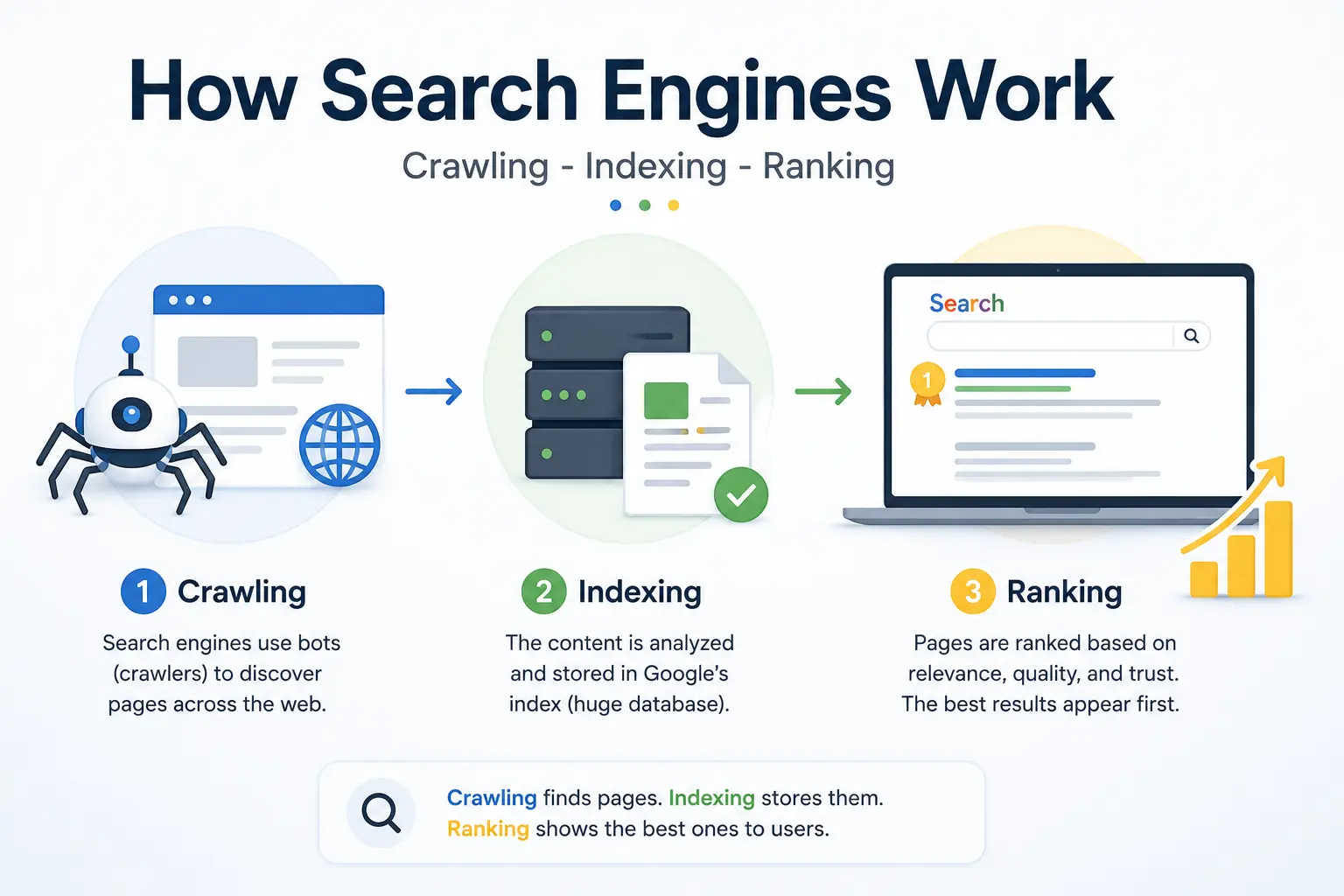
To fully understand What Is SEO, it’s helpful to know how search engines process websites.
Although search engines use complex algorithms, the basic process involves three stages:
1. Crawling
Search engines use automated programs called crawlers or bots to discover new and updated web pages by following links across the internet.
If a page can’t be crawled, it may not appear in search results.
2. Indexing
After a page is discovered, search engines analyze its content and store relevant information in their index.
A page that isn’t indexed generally won’t appear in search results.
3. Ranking
When someone performs a search, the search engine evaluates many factors—such as relevance, quality, authority, and user experience—to determine which pages best answer the query.
The goal is to provide the most useful results for the searcher’s intent.
Types of SEO
If you’re learning What Is SEO, you’ll also come across different categories of optimization. Each plays a unique role in improving your website’s visibility.
On-Page SEO
On-Page SEO focuses on optimizing elements within your website, including:
- Page titles
- Meta descriptions
- Headings (H1–H6)
- Content quality
- Keyword placement
- Internal links
- Images and ALT text
- URL structure
Well-optimized pages are easier for search engines to understand and more useful for readers.
Off-Page SEO
Off-Page SEO refers to activities outside your website that help build authority and trust.
Examples include:
- High-quality backlinks
- Brand mentions
- Guest posting
- Digital PR
- Social sharing (indirectly supporting visibility)
A strong reputation can improve your site’s ability to rank.
Technical SEO
Technical SEO ensures search engines can efficiently crawl, index, and understand your website.
It includes:
- Website speed
- Mobile responsiveness
- XML sitemaps
- Robots.txt
- HTTPS security
- Structured data (Schema)
- Canonical tags
- Core Web Vitals
Good technical SEO creates a solid foundation for all other optimization efforts.
Local SEO
Local SEO helps businesses appear in location-based searches such as:
- Restaurants
- Clinics
- Salons
- Service providers
- Retail stores
Optimizing your business profile, local citations, and location-specific content can improve visibility in local search results.
E-commerce SEO
Online stores use SEO to optimize:
- Product pages
- Category pages
- Product descriptions
- Images
- Reviews
- Navigation
This helps shoppers find products through search engines.
Why SEO Matters in 2026
Search behavior continues to evolve. People now use:
- Traditional search engines
- Voice assistants
- AI-powered search experiences
- Conversational search tools
This means SEO is no longer just about keywords. It also involves creating content that answers real questions, demonstrates expertise, and is easy for both people and AI systems to understand.
Modern SEO emphasizes:
- Helpful, original content
- Clear page structure
- Fast performance
- Trustworthy information
- User-focused design
By focusing on these principles, you improve your chances of reaching users regardless of how they search.
How Does SEO Work?
Now that you understand What Is SEO, the next question is: How does SEO actually work?
SEO works by helping search engines understand your website and determine whether it deserves to appear in search results for a specific keyword or question.
When someone searches on Google, the search engine doesn’t randomly choose websites. Instead, it evaluates hundreds of ranking signals to decide which pages are the most helpful, trustworthy, and relevant.
Think of SEO as improving three key areas:
- Content Quality – Does your page answer the user’s question?
- Website Experience – Is your website fast, mobile-friendly, and easy to navigate?
- Authority & Trust – Do other reputable websites recommend your content?
When these elements work together, your chances of ranking higher improve significantly.
What Is Keyword Research in SEO?
One of the most important parts of understanding What Is SEO is learning about keyword research.
A keyword is the word or phrase people type into search engines.
Examples include:
- What Is SEO
- Best Gaming Laptops
- Best AI Tools
- How to Start Affiliate Marketing
- SEO Checklist
Keyword research helps you discover:
- What
- people are searching for
- How many people search each month
- How difficult it is to rank
- What users actually want
Instead of guessing topics, successful websites create content based on keyword research.
Example
Imagine you own a digital marketing blog.
Instead of writing:
“Ways to Improve Websites”
You could target a keyword people actually search for:
What Is SEO
Because real users search for that exact phrase, your content has a much better chance of attracting organic traffic.
Understanding Search Intent
Search engines don’t just look at keywords—they try to understand why someone is searching.
This is called Search Intent.
There are four main types:
1. Informational Intent
The user wants to learn something.
Examples:
- What Is SEO
- How SEO Works
- What Is Digital Marketing
2. Navigational Intent
The user is looking for a specific website.
Examples:
- Google Search Console
- Ahrefs Login
- YouTube Studio
3. Commercial Investigation
The user is comparing products before making a decision.
Examples:
- Best Gaming Laptops
- Best SEO Tools
- Semrush vs Ahrefs
4. Transactional Intent
The user is ready to take action.
Examples:
- Buy Gaming Laptop
- Buy SEO Software
- Hostinger Discount
Understanding search intent helps you create content that matches what users are actually looking for.
On-Page SEO: Optimizing Your Website Content
When learning What Is SEO, you’ll frequently hear about On-Page SEO.
On-Page SEO refers to optimizing everything on your webpage to improve its visibility and usefulness.
Important On-Page SEO Elements
1. SEO-Friendly Titles
Your title should:
- Include the primary keyword
- Be compelling
- Clearly describe the page
Example:
✅ What Is SEO? A Complete Beginner’s Guide (2026)
2. Proper Heading Structure
Use headings logically.
Example:
H1
 ├── H2
 │     ├── H3
 │     ├── H3
 ├── H2
│ ├── H33. High-Quality Content
Google rewards content that is:
- Original
- Helpful
- Accurate
- Well-organized
- Easy to read
Instead of writing for search engines, write for people first.
4. Internal Linking
Internal links connect one page of your website to another.
For example, if you’re learning advanced search techniques after understanding What Is SEO, you can continue with our guide:
👉 7 Google Search Tricks Every SEO Professional Should Know (2026)
This article explains practical Google search operators that help with keyword research, competitor analysis, and finding SEO opportunities more efficiently.
Why internal links matter:
- Help users discover related content.
- Improve website navigation.
- Spread authority across your pages.
- Help search engines crawl and understand your site structure.
My Info Mint Tip: Every blog should include 3–8 relevant internal links to related articles where they naturally fit. Avoid adding links that don’t provide additional value.
5. Image Optimization
Images should include:
- Descriptive file names
- ALT text
- Appropriate compression
- Modern formats like WebP
Optimized images improve accessibility and page speed.
Technical SEO: The Foundation of a Healthy Website
Even the best content may struggle to rank if your website has technical issues.
Technical SEO focuses on making your website easy for search engines to crawl, index, and understand.
Important areas include:
- HTTPS security
- XML Sitemap
- Robots.txt
- Mobile responsiveness
- Fast page loading
- Structured data
- Canonical tags
- Core Web Vitals
Think of Technical SEO as building a strong foundation before constructing a house.
Off-Page SEO: Building Authority
Another important part of What Is SEO is understanding Off-Page SEO.
Off-Page SEO involves activities outside your website that help improve your reputation.
Examples include:
- Earning backlinks from trusted websites
- Guest posting
- Digital PR
- Brand mentions
- Industry citations
High-quality backlinks act like recommendations. When reputable websites link to your content, search engines may view your site as more trustworthy.
Remember, quality matters far more than quantity.
Local SEO: Reaching Nearby Customers
If you run a local business, Local SEO helps people find you when searching for services nearby.
Examples:
- Best dentist near me
- Coffee shop in Ahmedabad
- SEO agency in Gujarat
Local SEO includes:
- Optimizing your Google Business Profile
- Collecting customer reviews
- Maintaining consistent business information
- Creating location-specific content
For businesses serving a local audience, Local SEO can drive highly targeted traffic.
Common SEO Mistakes Beginners Should Avoid
Many beginners make avoidable mistakes that slow their progress.
Here are some of the most common:
- Stuffing keywords unnaturally into content.
- Publishing thin or duplicate content.
- Ignoring user intent.
- Forgetting internal links.
- Writing vague page titles.
- Neglecting mobile optimization.
- Failing to update older articles.
- Chasing backlinks instead of earning them.
- Ignoring page speed.
- Focusing only on rankings instead of helping users.
Avoiding these mistakes will give your website a stronger foundation for long-term growth.’
SEO Best Practices for 2026
Understanding What Is SEO is only the first step. To achieve long-term success, you need to follow modern SEO practices that focus on helping users rather than trying to manipulate search engine rankings.
Search engines are becoming smarter every year. They now evaluate content based on quality, relevance, user experience, expertise, and trustworthiness. Websites that consistently provide valuable information are more likely to earn higher rankings.
Here are the most important SEO best practices to follow in 2026.
1. Create Helpful, People-First Content
The foundation of successful SEO is creating content that genuinely helps readers solve a problem or answer a question.
Instead of writing only for search engines, focus on:
- Answering user questions clearly
- Using simple, easy-to-understand language
- Including real examples
- Updating outdated information regularly
- Providing actionable advice
Example:
Instead of simply defining SEO, explain how someone can start improving their website today.
2. Understand Search Intent
Every search has a purpose.
Before writing an article, ask yourself:
- Is the user trying to learn?
- Compare products?
- Find a website?
- Buy something?
Content that matches user intent performs better because it directly satisfies the searcher’s needs.
3. Improve User Experience (UX)
Google rewards websites that offer a smooth browsing experience.
Focus on:
- Fast page speed
- Mobile-friendly design
- Clear navigation
- Readable fonts
- Short paragraphs
- Descriptive headings
- Accessible images with ALT text
A better user experience often leads to longer time on page and lower bounce rates.
4. Build Topic Clusters
Instead of publishing unrelated articles, organize your content into pillar pages and supporting articles.
For example:
Pillar Page
What Is SEO? A Complete Beginner’s Guide (2026)
Supporting Articles
- On-Page SEO Checklist
- Technical SEO Checklist
- Keyword Research Guide
- Image SEO Guide
- Internal Linking Best Practices
- Schema Markup Explained
- 7 Google Search Tricks Every SEO Professional Should Know (2026)
- Google Search Console Guide
This structure helps search engines understand that your website covers SEO comprehensively, increasing your authority on the topic.
5. Optimize for Featured Snippets
Featured snippets appear at the top of many search results and are often used by AI-powered search systems.
To improve your chances:
- Answer questions in 40–60 words
- Use numbered lists
- Create comparison tables
- Write clear definitions
- Add FAQ sections
Example:
What Is SEO?
SEO (Search Engine Optimization) is the process of improving a website’s visibility in search engine results by optimizing content, technical performance, user experience, and authority to attract organic traffic.
6. Keep Content Fresh
SEO isn’t a one-time task.
Review and update important articles every 6–12 months by:
- Adding new examples
- Refreshing statistics
- Removing outdated information
- Expanding sections
- Improving internal links
Fresh, accurate content is more valuable to both users and search engines.
What Is AEO (Answer Engine Optimization)?
As AI assistants and voice search become more popular, Answer Engine Optimization (AEO) has become an important extension of traditional SEO.
AEO focuses on creating content that directly answers user questions in a clear and concise way.
Instead of only trying to rank in search results, AEO aims to become the answer used by:
- Google AI Overviews
- Voice assistants
- ChatGPT
- Gemini
- Perplexity
- Other AI-powered search tools
How to Optimize for AEO
Follow these best practices:
- Start sections with a direct answer.
- Use question-based headings.
- Write concise definitions before expanding on the topic.
- Include FAQ sections.
- Use structured data (FAQ Schema, HowTo Schema where appropriate).
- Organize content with clear headings and bullet points.
Example
Question: What Is SEO?
Direct Answer:
SEO (Search Engine Optimization) is the process of improving a website so it ranks higher in search engine results and attracts more organic traffic.
This format is easier for AI systems to understand and quote.
What Is GEO (Generative Engine Optimization)?
Generative Engine Optimization (GEO) is the practice of optimizing content so AI-powered search engines can easily understand, summarize, and reference it when generating answers.
Unlike traditional SEO, GEO focuses on making your content useful not only for search engines but also for AI systems.
Examples include:
- ChatGPT
- Google AI Mode and AI Overviews
- Gemini
- Perplexity
- Microsoft Copilot
GEO Best Practices
To improve your chances of being referenced by AI-generated answers:
- Write original, well-researched content.
- Use descriptive headings.
- Explain concepts clearly.
- Include definitions and examples.
- Support claims with reliable sources where appropriate.
- Use logical content structure.
- Avoid keyword stuffing.
- Keep information up to date.
Well-structured content is easier for AI systems to interpret accurately.
Understanding EEAT
Google evaluates content quality using the concept of EEAT, which stands for:
- Experience
- Expertise
- Authoritativeness
- Trustworthiness
These signals help search engines determine whether your content is reliable.
How to Improve EEAT
You can strengthen your content by:
- Publishing accurate information.
- Citing reputable sources when needed.
- Updating content regularly.
- Demonstrating practical knowledge.
- Maintaining clear contact and about pages.
- Being transparent about affiliate relationships.
- Correcting outdated or inaccurate information promptly.
Building trust takes time, but it plays an important role in long-term SEO success.
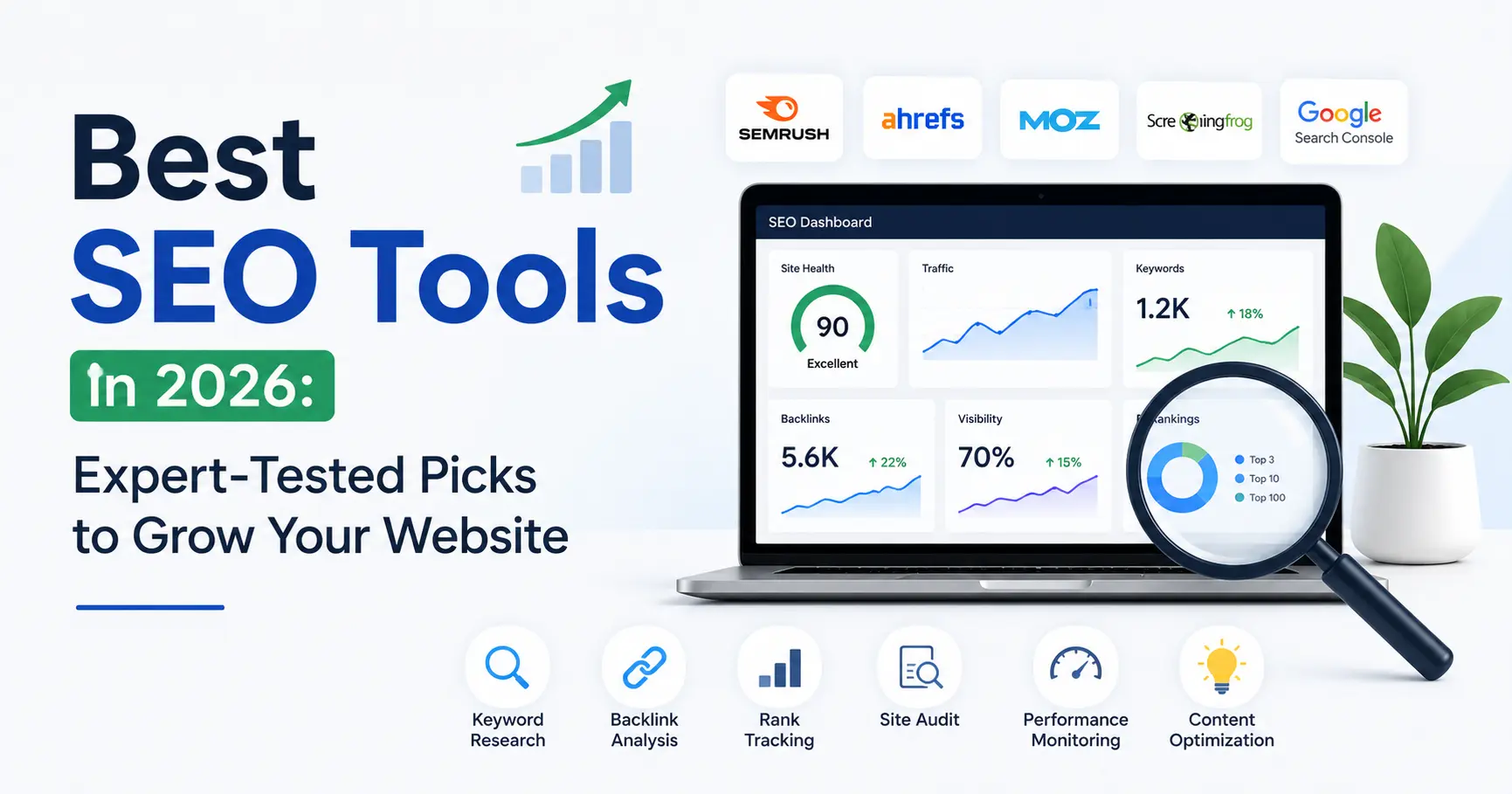
Essential SEO Tools for Beginners
The right tools can simplify your SEO efforts.
Free Tools
- Google Search Console
- Google Analytics 4
- Google Keyword Planner
- Google Trends
- PageSpeed Insights
- Bing Webmaster Tools
Paid Tools
- Ahrefs
- Semrush
- Screaming Frog SEO Spider
- SE Ranking
- Surfer SEO
- Clearscope
Start with free tools if you’re new to SEO. As your website grows, paid tools can provide deeper insights into keywords, competitors, backlinks, and technical issues.
Beginner SEO Checklist
Use this checklist whenever you publish a new article.
Keyword Optimization
- Identify one primary keyword.
- Add the keyword naturally to the title, introduction, headings, and conclusion.
- Include related keywords where relevant.
Content Quality
- Answer the user’s main question early.
- Cover the topic in depth.
- Use clear examples.
- Break up long paragraphs.
On-Page SEO
- Write a compelling SEO title.
- Create a unique meta description.
- Use one H1 heading.
- Structure content with H2 and H3 headings.
- Add descriptive image ALT text.
Technical SEO
- Ensure the page loads quickly.
- Check mobile responsiveness.
- Use HTTPS.
- Submit your XML sitemap.
- Verify indexing in Google Search Console.
Internal Linking
Link to related articles naturally. For example:
- 7 Google Search Tricks Every SEO Professional Should Know (2026) – Learn advanced Google search operators for faster research and smarter SEO workflows.
- On-Page SEO Checklist (2026)
- Technical SEO Checklist
- Keyword Research Guide for Beginners
- Google Search Console Guide
These internal links help readers continue learning while strengthening your site’s topical authority.
Key Takeaway
SEO in 2026 is no longer just about adding keywords to a page. Success comes from creating content that is helpful, trustworthy, easy to navigate, and structured in a way that both people and AI systems can understand.
By combining traditional SEO with AEO, GEO, and strong EEAT practices, you’ll build content that has a better chance of performing well across search engines and AI-powered discovery platforms.
Frequently Asked Questions (FAQs)
1. What Is SEO in simple words?
SEO (Search Engine Optimization) is the process of improving a website so it appears higher in search engine results like Google. The goal is to attract more organic (free) traffic by creating helpful content and optimizing your website for users and search engines.
2. Why is SEO important?
SEO helps increase website visibility, attract targeted visitors, build brand credibility, and generate long-term organic traffic without relying entirely on paid advertising.
3. Is SEO free?
SEO itself doesn’t require paying Google to rank. However, you may invest in tools, content creation, website improvements, or professional SEO services to achieve better results.
4. How long does SEO take to show results?
SEO is a long-term strategy. Depending on your website’s authority, competition, and content quality, noticeable improvements often take 3 to 6 months, while highly competitive keywords may take longer.
5. What are the main types of SEO?
The four primary types of SEO are:
- On-Page SEO
- Off-Page SEO
- Technical SEO
- Local SEO
For online stores, E-commerce SEO is also an important specialization.
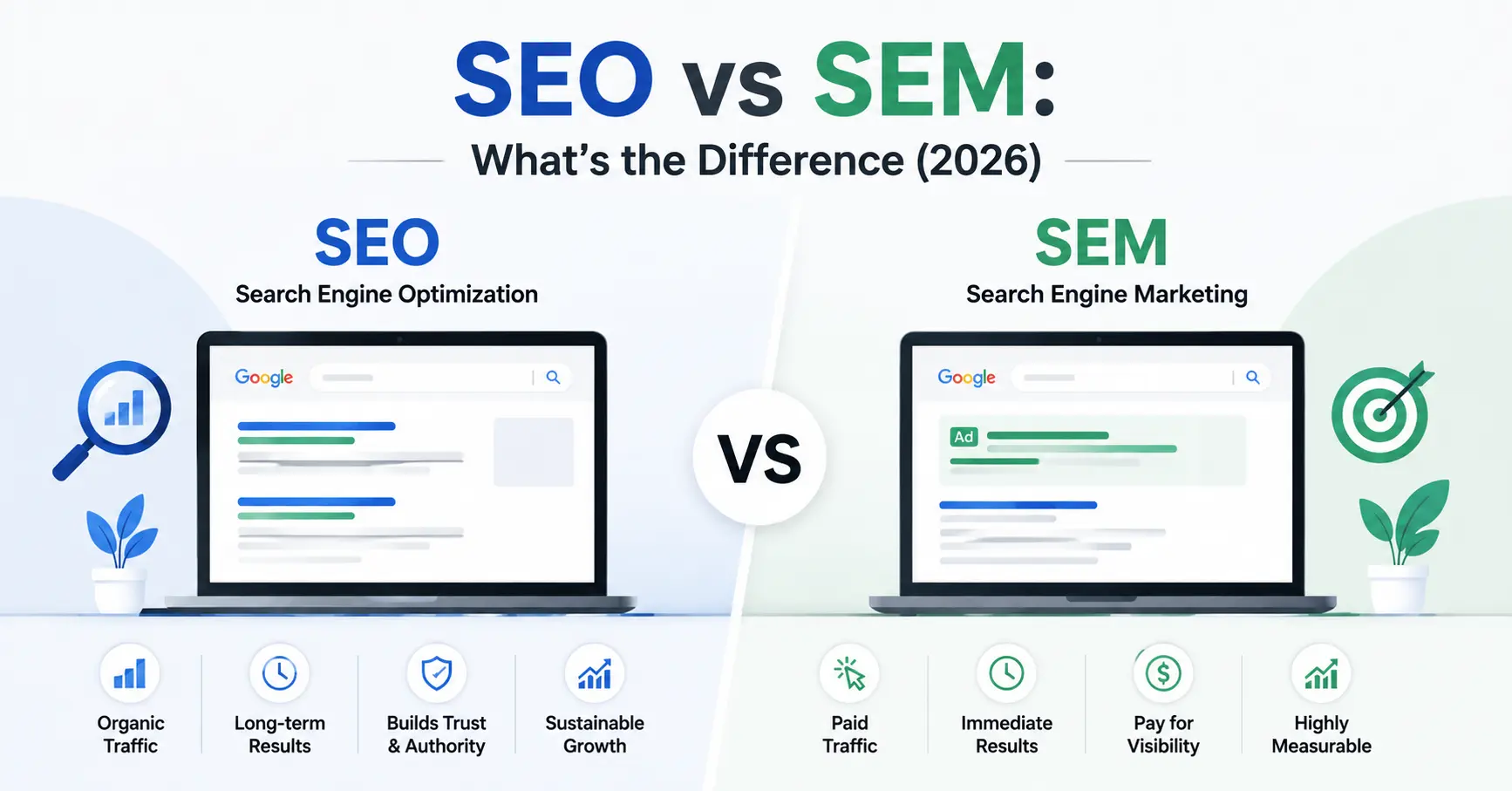
6. What is the difference between SEO and SEM?
SEO focuses on earning organic traffic through optimization, while Search Engine Marketing (SEM) includes paid advertising, such as Google Ads, to gain visibility in search results.
7. What is a keyword in SEO?
A keyword is the word or phrase people type into a search engine. Keyword research helps identify what your audience is searching for so you can create relevant content.
8. Can I learn SEO without technical knowledge?
Yes. Many people begin by learning the basics of keyword research, content optimization, and website structure. As your experience grows, you can gradually explore more advanced technical SEO concepts.
9. Is SEO still worth learning in 2026?
Absolutely. As long as people use search engines and AI-powered search tools to find information, SEO remains a valuable skill for businesses, bloggers, marketers, and content creators.
10. Does AI replace SEO?
No. AI changes how people search, but SEO continues to evolve alongside it. Today, successful websites combine traditional SEO with Answer Engine Optimization (AEO) and Generative Engine Optimization (GEO) to improve visibility across both search engines and AI-powered platforms.
11. What is the difference between SEO, AEO, and GEO?
- SEO helps your website rank in search engine results.
- AEO focuses on providing direct, concise answers for search engines and voice assistants.
- GEO optimizes content so AI-powered search tools can understand, summarize, and reference it accurately.
Together, these approaches create a stronger foundation for modern search visibility.
12. What are the best free SEO tools?
Some popular free tools include:
- Google Search Console
- Google Analytics 4
- Google Keyword Planner
- Google Trends
- Google PageSpeed Insights
- Bing Webmaster Tools
These tools help monitor performance, identify technical issues, and discover keyword opportunities.
13. How often should I update SEO content?
Review important articles every 6–12 months. Update outdated information, improve internal links, add new examples, and expand sections where necessary to keep content relevant.
14. What is the biggest SEO mistake beginners make?
One of the most common mistakes is focusing only on keywords instead of solving the reader’s problem. Modern SEO rewards content that is useful, trustworthy, and written for people first.
15. How can I start learning SEO today?
Start with the basics:
- Learn how search engines work.
- Understand keyword research.
- Practice writing SEO-friendly content.
- Learn on-page optimization.
- Explore technical SEO fundamentals.
- Use free tools like Google Search Console and Google Analytics 4 to analyze your website.
Final Thoughts
If you started this guide wondering What Is SEO, you now have a solid understanding of the fundamentals and how SEO fits into today’s digital landscape.
SEO is no longer about simply adding keywords to a webpage. Modern optimization is about creating content that answers real questions, provides genuine value, and delivers an excellent user experience.
By combining:
- Helpful, people-first content
- Strong technical foundations
- Clear website structure
- Strategic internal linking
- High-quality backlinks
- AEO techniques for direct answers
- GEO techniques for AI-powered search
you’ll be well-positioned to build sustainable organic visibility over time.
Remember, SEO is an ongoing process. Continue learning, testing, and improving your content as search technology evolves.
Conclusion
SEO is one of the most valuable long-term digital marketing skills because it helps people discover useful content, products, and services through organic search.
As search continues to evolve with AI-powered experiences, the core principles remain the same: create original, helpful, trustworthy content that satisfies user intent. By understanding What Is SEO and applying the best practices covered in this guide, you’ll be better prepared to grow your website, improve visibility, and reach your audience across both traditional search engines and modern AI platforms.
Whether you’re starting a personal blog, managing a business website, or building an online brand, consistent learning and regular content improvements will be the key to long-term SEO success.